
THE RESEARCH:
CREATIVITY x NATURE x HEALTH = FULL RESET
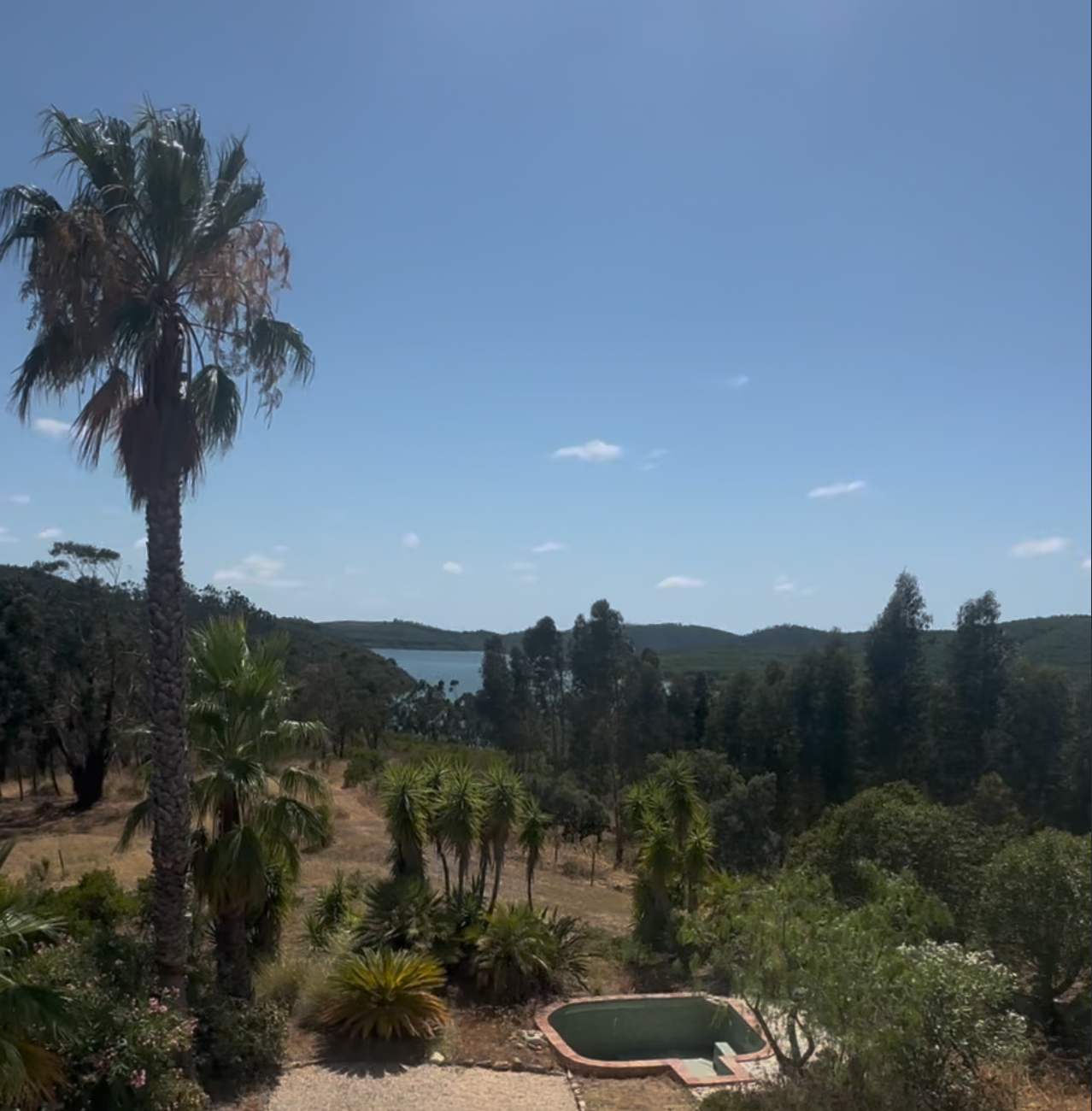
View from Casa Bravura on Barragem de Bravura. On the right the land of the Bravura Project.
For the moments when someone asks
“why ceramics?”
What happens to the brain and body when you work with your hands inside a living landscape is not anecdotal. It is measurable, reproducible, and increasingly well-documented. This page collects the science behind what
Brava Cerâmica participants experience every week.
01
The gap Brava fills
HANDS, HEART, HEALTH & NATURE: A RESET NO THERAPY CAN REPLICATE.
No published study has yet combined all three variables simultaneously: working with clay, inside nature, eating healthy food, sharing experiences with inspiring people and movement over multiple consecutive days.
That is exactly what Brava Ceramica is.
The accumulated effect of cortisol reduction, parasympathetic restoration, alpha wave creativity, dopamine reward cycles, and attentional recovery running in parallel, compounding daily.
This is not a hypothesis. It is what participants experience and what the science, taken together, would predict. The research exists in pieces. Brava Cerâmica is where those pieces become a whole.
02
Our health improves when our hands work with clay
Cortisol drops in 45 minutes.
A study published in the Journal of the American Art Therapy Association measured cortisol levels before and after 45 minutes of self-directed clay work. Cortisol — the body's primary stress hormone — dropped significantly across participants, regardless of skill level or the quality of what they produced. The act of working the material was enough.
Clay activates millions of nerve endings
More brain area is devoted to the sensitivity and movement of the hands than almost any other part of the body. Clay simultaneously activates millions of nerve endings, creating a density of sensory feedback that is difficult to replicate with any other material. Complex hand movements strengthen neural pathways and measurably improve cognitive function.
The brain enters a different state.
Working with clay elevates theta and gamma wave frequencies — the brain states associated with deep creativity, flow, and spatial-temporal processing. The prefrontal cortex — the seat of worry, planning, and self-criticism — is redirected toward sensory processing and motor control. Mental chatter quiets, not by effort, but by occupation.
Dopamine fires with every small completion.
Each step: a coil formed, a wall raised, a piece that holds its shape, triggers a small dopamine release through the brain's reward system. Over six days, this compounds. The nervous system begins to associate the studio with a reliable sense of progress and pleasure.
Stress reduces up to 75%.
Studies measuring a range of hand crafts (pottery, knitting, painting) found stress level reductions of up to 75%. The mechanism is consistent: repetitive, focused physical activity redirects the nervous system away from threat-response and toward restoration.
03
Our brain relaxes when we spend time in nature
Ten minutes changes the chemistry.
A 2025 meta-analysis published in Behavioral Sciences found that a single 10-minute nature immersion produces measurable physiological change: salivary cortisol drops 21%, and a key stress biomarker falls 28%. The effect begins almost immediately.
Twenty minutes shifts the nervous system.
At 20–30 minutes, the effect deepens. The autonomic nervous system shifts from sympathetic dominance (fight/flight/freeze) toward parasympathetic dominance — the state of rest, repair, and receptivity. Heart rate and blood pressure fall. The body stops bracing.
The amygdala quiets.
Brain imaging studies show that nature exposure decreases activity in the amygdala — the brain's threat-detection centre. Less threat response means more capacity for creative thought, emotional regulation, and genuine attention.
The effects last.
Japan's Forest Medicine Society has documented that time among trees increases natural killer cell activity — a key immune system marker — for up to 30 days after a single exposure. The body does not forget quickly.
The prefrontal cortex recovers.
A comprehensive review published in Neuroscience & Biobehavioral Reviews (2026) synthesised neuroimaging findings from EEG, fMRI and structural MRI studies. Conclusion: exposure to natural stimuli consistently reduces activity in stress-related and self-referential brain circuits and shifts the brain toward states consistent with attentional restoration. In plain language: nature gives the thinking mind a rest so the rest of you can operate.
04
Our creative problem-solving improves by 50% when we spend time in nature
Four days in nature. Creativity up 50%.
A study published in PLOS ONE found that four days of immersion in nature — away from screens and urban environments — increased performance on creative problem-solving tasks by 50%. The effect was robust across participants. Hikers performed twice as well on creative thinking tests upon return from nature exposure than before.
Alpha waves and divergent thinking.
EEG research comparing indoor and outdoor exercise found that alpha band activity in the parietal-occipital region — the area associated with divergent creative thinking — increased significantly after outdoor creative work. It did not increase in the same participants working indoors. The environment changes the brain's creative capacity, not just its comfort.
Nature restores the attention that creativity requires.
Attention Restoration Theory, developed at the University of Michigan, holds that nature allows the directed attention system to recover — the cognitive resource most depleted by modern working life and most necessary for sustained creative thought. Memory and cognitive performance improve up to 20% after a nature walk, an effect not seen after an urban walk of equal length.
Awe opens the mind.
Nature is one of the primary triggers of awe — the psychological state associated with a sense of vastness, connectedness, and expanded time perception. Research links awe to increased openness to new ideas, reduced self-focus, and a deeper willingness to engage with complexity. The west Algarve at dusk produces this reliably.
Clear head. Calm nervous system.
Fired-up creativity.
Leave with stronger skills, work you’re proud of, new friends, and that strange combination of being tired yet feeling rested and reset, wondering how six days somehow feel so much longer.
All that, and an unstoppable urge to keep making.